Neon LED sculpture in space, 2025



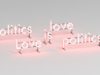
This neon phrase questions the boundary between the intimate and the political, pointing to the fact that love never exists outside structures of power, and that politics inevitably touches the personal.
According to Alain Badiou, love is not merely a personal emotion but a political event. For Badiou, love disrupts existing structures and brings transformation — an inherently political act, as it changes the way people live and act together. Love is politics — just as politics shapes power and social relations, love reshapes the relationships between people, opening space for new forms of solidarity, community, and change. As a political event, love questions existing norms and enables the imagination of a more just world grounded in compassion, justice, and the common good — counter to a capitalist system that often dehumanizes individuals, deepens inequality, and divides society. Love in politics is not naïve — it is a radical act of resistance against exclusion and injustice.
This work interrogates how political systems — particularly capitalism — shape our understanding of love and intimate relationships. At the same time, it invites us to reflect on how, as individuals, we choose to read and interpret the world around us.
The neon sculpture offers a dual reading — either as linked sentences, “Love is politics. Politics is love,” or as separate statements, “Love is love. Politics is politics.” This ambiguity invites critical reflection: What do we choose to see? And how do we decide to act?
This work is a call to resist dehumanizing politics by rethinking how we read the world — and how we choose to be present, accountable, and active within it, every day.
Inspired by the protests in Serbia, where one of the slogans was “Only Love,” this neon work expresses solidarity with the demonstrators and advocates for a politics rooted in care, compassion, and resistance.
In the current context, it also resonates with Gaza, with ongoing wars, and with the devastation of our shared humanity.
The work invites us to actively reflect on how to build a world in which love, care, and solidarity form the very foundation of politics—and why, today, care and solidarity are the most vital and most subversive political acts.
This work is not only a critique of the existing system but also an invitation to reconsider social and economic inequalities. It urges us to imagine how we might build a world where love, care, and community form the foundations of political life — and why, in today’s world, care and solidarity may be the most vital and subversive political acts of all.
This neon calls for a new political vision — one in which love becomes a tool of mobilization and resistance.